
Is your accommodation ready for direct bookings?

How about starting this post with one absolutely wild fact?
In 2025, AirBnB, Booking, Expedia and Trip.com spent a combined ~2,500 billion ISK on sales and marketing.

To put that number into perspective, it's roughly half of Iceland's entire GDP for the same year. Half of the Icelandic economy — just to reach customers. 🤯
As we discussed in a previous post, the commission we pay these companies isn't just a cost. It buys us access to that massive sales and marketing machine.
That's what lets us start selling when we don't have the time or money to handle our own sales and marketing.
But then comes the point where we want to see more krónur land in our own pockets. Fewer bookings through Booking and Expedia, with all their commissions attached.
What then?
To get more direct bookings, we need to step more firmly into the sales and marketing side ourselves.
Even though it might seem like we're up against impossible odds when we hear those numbers, the good news is there's plenty we can do.
We just need to start somewhere.
1. Be ready to receive the booking
Your website is your most important sales channel
You've probably heard this before, but clichés are clichés for a reason: you need a good, accessible website to get more direct bookings.
When travelers land on your site, they need to immediately understand what kind of accommodation you offer — and who it's for.
If your target audience is well-paying travelers in their prime years, photos of nightlife are likely to scare them off. By the same token, hip and cool TikTok tourists aren't going to respond well to photos of grey-haired grandpas with fanny packs.
So the website needs to set the right tone from the very first touch, with imagery and copy that speaks to the right crowd.
It also needs to be easy to figure out:
where the accommodation is located
what kinds of rooms are available
and what the place and its surroundings have to offer
Make the booking process as easy as humanly possible
To get direct bookings, you need a booking engine on your site. While it usually charges a commission per booking, it's typically lower than what the OTAs charge — and therefore a worthwhile investment.
The booking engine needs to be clearly visible and accessible. You don't want people having to click around endlessly to find it, and it needs to be simple to use. For younger audiences especially, it's crucial that the booking process works smoothly on mobile.
The goal is for the booking process to go as frictionlessly as possible. Avoid any unnecessary steps — like requiring the customer to create an account — and limit the information you ask for to what's actually necessary.
The more obstacles in the process, the more likely the customer is to abandon it midway.
Trust matters above all in online transactions
We're asking people to trust us with their credit card details. That alone places certain demands on how we present ourselves online.
Increased coverage of cybersecurity and online scams has made people more cautious of websites they don't recognize. That's why we need to do everything we can to show that we're trustworthy.
That applies to both visuals and copy. It's easy, for example, to have AI write your text — but if it doesn't sound like an actual human wrote it, red flags automatically go up in customers' minds.
We also need to put everything on the table that the customer needs in order to make a decision: prices, cancellation policies, information about the service, reviews from previous guests, and anything else that matters.
If it's hard to book with you, customers will simply go where it's easier.
2. Grab the people who are already searching
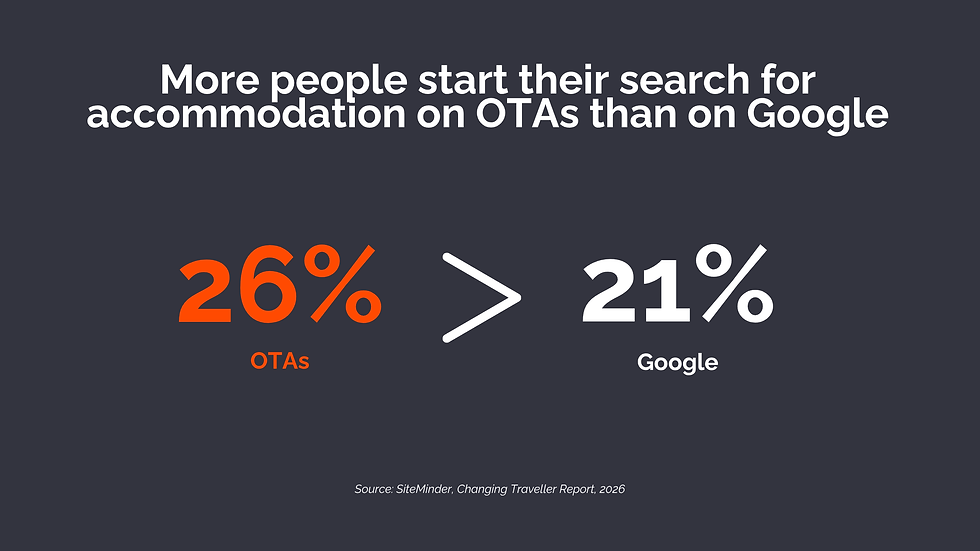
In the post we mentioned earlier in this article — about how bookings happen on OTAs — we shared statistics showing that 26% of travelers begin their search for accommodation on sites like Booking.com. That post also mentioned that 18% start their search there but then book directly on the accommodation's website. And then there are those who have seen the accommodation's name in media coverage or gotten recommendations from friends and family.
In plain language, this simply means there's always a certain group of guests who are actively looking for your accommodation specifically. The question isn't whether they exist — it's whether you'll manage to catch them.
One of the simplest ways to do that is to make better use of your Google My Business profile.
Google My Business is an incredibly powerful — and often underused — tool

If someone searches for your accommodation on Google, your Google My Business profile is very likely the first thing they'll see. Before they go to your website. Before they check Booking.com.
So you can think of the profile as a kind of front page on Google.
It costs nothing to set up, but the profile can have a significant impact on the first impression a guest gets of your accommodation.
How do you get the most out of the profile?
It doesn't have to be complicated, but it does need to be done well.
First, it matters that the profile is filled out properly. It's not enough to just put in a name and a location. The information needs to be accurate and clear, the description needs to say what you offer, and the categorization needs to match what you're actually selling.
Second, photos matter a lot. First impressions are often formed here, so it matters that the imagery gives the right picture of the place. That applies not just to the rooms themselves, but also to the surroundings and the atmosphere.
Third, reviews are one of the most important factors. People trust other guests, so it matters to encourage customers to leave reviews. And just as importantly, to respond to them. That goes for both positive and negative reviews.
Finally, you need to keep the profile alive. Update photos now and then, answer questions, and make sure all information is correct. A dead profile sends a simple message: that this touchpoint isn't being cared for.
Make sure you can be found on search engines — and that people actually want to click
People who aren't experts in digital marketing sometimes have a mild panic attack when SEO comes up. Yes, SEO can be made very complicated, but there are a few fundamentals everyone should be able to update on their own.
When someone finds you on Google, the result should be such that it's obvious to click on it.
You can test this yourself:
Google your accommodation and look at how the results appear.
Is the URL and the text beneath it trust-inspiring?
Does it give a good sense of what you offer?
Would you click?
If the answer is no, then there's room for improvement.
We may write a separate article about SEO for accommodations later, but until then, here are simple guidelines from Google on how SEO works and what's good to keep in mind.
3. Give people a reason to choose you
What most people in Icelandic tourism stumble on is differentiation. We need to give guests a real reason to choose us over others.
What makes your accommodation special? Is it the atmosphere, the story behind the place, the location, or something you simply do better than anyone else?
Often the answer is something along the lines of being close to unique natural wonders. That's certainly true — but in Iceland, that applies to a lot of places. So it rarely works on its own. We need to put it in context and make it our own.
Branding theory also teaches us how we can use colors, logos, tone, and brand voice for differentiation.
If we can't give a clear reason to choose us over others, price often becomes the main factor in the decision. Or simply the convenience of booking through a site like Booking.
You're not just selling rooms and beds
Tourism is to a large extent about experiences, and accommodations are no exception. While some guests are simply looking for the cheapest option, many — if not more — are looking for a certain atmosphere and experience.
If we're going to land more direct bookings, we need to make that experience visible. We don't do that by listing room types or square meters — we do it by showing what it's like to stay with us.
What the mornings look like. How the evenings flow. What feeling guests take home with them.
The website, social media, and other content we put out should all work together to showcase that uniqueness.
Don't just tell people what you offer — help them see and feel what they're missing if they choose someone else.
The foundation of everything is knowing who "your guest" is.
If you don't know who you're talking to, it's hard to explain why they should choose you. But once that's clear, everything else becomes simpler.
You don't need to be for everyone. In fact, that's rarely an advantage. Because when someone sees your place and thinks "this is exactly for me," the decision becomes much easier.
And the odds of a direct booking go up.
4. Nurture the relationship
It's often said that it's 5–25 times harder to acquire new customers than to keep the ones you already have.

.
Guests at Icelandic accommodations admittedly rarely come back again and again, but we still shouldn't underestimate that group. On top of that, there's enormous value hidden in recommendations and word of mouth from guests who share their experiences with friends, family, and even strangers — both in person and on social media.
We all know examples of this. Someone goes to get a haircut and starts telling their hairdresser about their trip to Iceland. Or a group of friends decides to take a trip together because one of them recommended the place.
These decisions aren't made in ad platforms. They're made in conversations.
That's why what happens after the stay matters.
You can, for example:
send guests a discount code for their next stay when they check out
share positive experiences guests have posted on social media themselves
collect email addresses and remind people of you regularly
This doesn't have to be complicated. It's simply about keeping the connection alive.
Recommendations and what happens after the stay are often one of the strongest drivers behind direct bookings.
5. You don't have to do everything at once!
Everything we've covered in this post are tasks that someone has to take on. These things don't just happen on their own, and it costs either time or money to fix them.
The good news is you don't have to do it all at once.
Small changes are better than no changes
We're not going to replace the OTAs overnight — we're just going to slowly raise the share of direct bookings. One step at a time.
You can think of this like interest and compound interest. Each action on its own moves you only slightly closer to the goal, but together, over a longer period of time, the returns become significant.
What matters is choosing where to start:
If the website is the biggest problem, start there.
If you get a lot of visitors but few bookings, look at how easy it is to book.
If you get few visitors, you need to focus on visibility.
You also don't have to do it all yourself
There are countless companies and specialists who can help you with this. The mistake many make is to turn to specialists before the problem has been defined.
If you don't know what needs to be fixed, it's hard to buy the right solution.
If the problem is, for example, that social media isn't being used strategically, then our social media tool here at Keeps can help you. We also offer a maintenance service where we handle the posting on your channels.
If visibility on search engines is weak, there are specialists who focus on that. The same goes for advertising.
By breaking this down into steps, the way we've done here, it also becomes easier to turn to the right people with the right tasks.
Because it matters little how much you spend on advertising if the website doesn't convert visitors into bookings.
No matter how you try, you can't fill a leaky bucket with water.
Finally
If you have plenty of money and unlimited time, you can make considerable progress fairly quickly in increasing the share of direct bookings.
But if that were the case, you probably wouldn't have made it to the end of this post. You'd already have all the best specialists on your team.
If you're running an accommodation in Iceland, chances are you're already wearing too many hats and juggling all the balls. And carrying all sorts of crushing costs.
This has to be doable.
There's no single magic solution that delivers a flood of direct bookings overnight.
Small, real improvements matter more than big plans that never become reality.


Comments