
Direct Bookings and OTAs: How Do Bookings Actually Happen?


There's an ongoing conversation within Icelandic tourism about how to increase the share of direct bookings to accommodations and tour operators. Many feel the sting of the commissions that OTAs (Online Travel Agencies) like Booking.com and Viator take from every booking, on top of all the other costs.
And those costs certainly aren't going down.
Keeps was born when the company's founder was working at Expedia and saw an opportunity to help Icelandic accommodations manage their photos and other content on OTAs. The connection to the OTAs has therefore been strong from the start — but we're also aware that it's in everyone's interest for the share of direct bookings to grow.
More money in the till for Icelandic businesses is good for all of us:
The accommodations and their owners, the customers who benefit from investment in better service, and society as a whole through higher tax revenues.
But why does such a large share of bookings still come through OTAs?
And what do we need to do to increase the share of direct bookings at our accommodation?
The reality for many Icelandic accommodations
Let's say we run a small 10-room hotel in South Iceland.
Labor costs in Iceland are high, and we try to keep staff numbers to a minimum. We don't have a full-time marketing person, but we may have made an agreement with a marketing agency or a contractor who helps us promote the hotel.
And then we have that one cousin who's really clever on Instagram.
The commission and what we get for it
Our little hotel pays OTAs like Booking.com a 15-22% commission.
We're probably paying commission at the higher end because it's harder to negotiate when you only have a few rooms. But in return, we get placement on OTAs that millions of travelers visit every day. In 2024, for example, an average of 3 million room nights were booked on Booking.com every single day.
Of course, not all of those guests were coming to Iceland, but it's worth keeping the scale in mind. It's also worth noting that Booking.com and related sites receive 18-19 million visits per day (roughly 560 million per month).
But let's put those numbers another way: to sell three million room nights every day, Booking.com needs to get 18-19 million people onto the site every day.

If we assume similar traveler behavior on our own website, that means we'd need about 100 visits to get three bookings.
How many visits does your website get per day, and how many bookings does it generate?
How does Booking.com get 560 million visits per month?
Now we're getting to the juicy part of this post: marketing.
OTAs like Booking.com spend amounts we can't even imagine to drive all that traffic.
There's a specialist in every seat: SEO, social media marketing, ads, placements, content writing, PR, and brand work. And much more. Booking.com was, for instance, a sponsor of the 2024 European Football Championship in Germany, where 5 billion people tuned in and saw the Booking.com logo flash by.
Suddenly the Instagram cousin isn't just David versus Goliath — she's a tiny freckle on the toe of David versus Goliath.
Time is on the OTAs' side
Effective marketing takes time. You can achieve quick wins with clever campaigns, but you always need some kind of mix of short- and long-term efforts.
Not only does Booking.com have a marketing budget that's impossible for a small business to compete with — the company has also been at it for decades.
Booking was founded in the Netherlands in 1996. Almost a decade later, in 2005, the Booking.com site launched. For over 20 years, Booking has been telling the same story: We're the place where you can book accommodation — no matter the destination.
The company may have used different words to shape the message, but the story has always been the same.
How do you find and book a hotel?
In the conversation about OTAs, we sometimes forget to think about how travelers actually behave during the booking process. Where do we ourselves start when we're looking for accommodation for our own trips?
Data from 2026 shows that 26% of travelers start their search for accommodation on OTAs like Booking.com, while 21% start on Google. This shows that booking sites have increasingly become the first place travelers turn to when planning a trip.
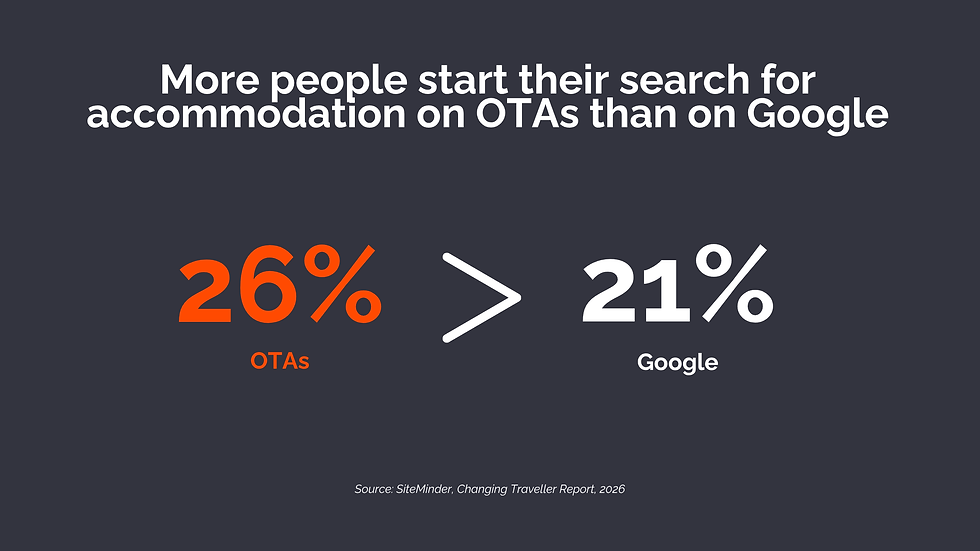
But the starting point is the OTA.
Travelers are used to being able to compare hotels, read reviews from other guests, and compare prices — even on an interactive map. This comparison has become part of trip planning for many people.
The good news is that the same numbers show that more travelers than before — 18% — start their search on OTAs but book directly on the hotel's website.
Commission costs money, but so does everything else
Now we're really getting to the heart of the matter: marketing always costs something.
In exchange for the commission, our little accommodation gets access to the OTA's sales and marketing machine. Instead of fighting Goliath for the attention of travelers, at least we're on his team.
That doesn't mean there isn't a lot to be gained from getting more direct bookings. But to make a decision about what to do next, we need to compare costs. And choose what's realistic for our situation. For our little 10-room hotel.
You can of course debate whether the commission is too high, or whether it's healthy that a site like Booking.com has all this influence through what's basically a monopoly position.
But that's material for another post.
So is getting direct bookings a lost cause?
No, not at all. We absolutely want to see more direct bookings. That's why, for example, Keeps has a social media tool that makes it easier for you to reach guests through those channels.
But to get more direct bookings, you need to invest in sales and marketing.
You need a website with a booking engine, plus copy and visuals that lead customers toward booking. You need to work intentionally on being found on Google, on social media, and increasingly in conversations with AI models.
But all of this costs.
Time. Money. Specialist know-how.
Or all of the above.
Just like the commission.
What you can do in the meantime
Even with access to the best possible specialists and unlimited funding, increasing the share of direct bookings will take time. It's best to view this as a long-term project.
And in the meantime, you need to make sure your accommodation stays visible through your current channels.
You can improve your visibility on OTAs with quality imagery that reflects both the accommodation and its surroundings. You could potentially list yourself on additional OTAs to cast a wider net. Or work on relationships with travel agencies that book higher-value guests with you.
The task isn't about choosing one or the other — it's about finding the right mix for your accommodation.

Comments